Tryon Vacuum Fluctuation
Maybe the universe is just a long-lived quantum fluctuation. Net energy: zero.
- Family status
- Speculative
- Proposed
- 1973
- Sources
- 1
- Reader votes
- 0
- Basis: theoretical
- The path integrals in its quantum cosmology calculations are still disputed, and no observation has tested any variant.
1The claim
The universe as a zero-energy quantum fluctuation, the historical first proposal.
2Why it might be true
Edward Tryon, in a one-page Nature paper in 1973, made the historically first version of the "universe from nothing" argument. His insight: the total energy of the universe may be zero, because the positive energy in matter and radiation is precisely cancelled by the negative gravitational potential energy. A zero-energy event can, in principle, fluctuate from vacuum.
His remark: "Our universe is simply one of those things which happens from time to time." This was a precursor to Vilenkin's more developed 1982 framework, but lacks the formal quantum cosmology machinery.
3Evidence so far
- Total energy of observable universe is consistent with zero
- Historically opened the question
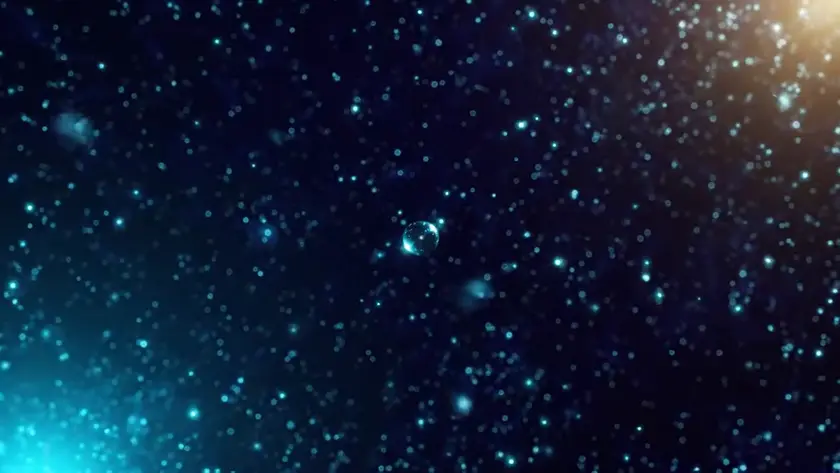
A scientific documentary visualization of Tryon's vacuum fluctuation proposal. Deep indigo space is alive with countless faint cyan flickers winking in and out, the restless zero-point activity of the quantum vacuum. Among the brief flickers, one near the center brightens and, instead of vanishing, persists and grows into a translucent cyan sphere with a warm-gold core, while the vacuum keeps flickering around it. The visualization conveys the variant's central claim that the universe is a zero-energy quantum fluctuation, one of those things that, given a restless vacuum, happens from time to time.
- Family status
- Speculative
Basis: theoretical
The path integrals in its quantum cosmology calculations are still disputed, and no observation has tested any variant.
- Variant status
- Historical
- Proposed
- 1973
- By
- Edward Tryon
- Sources
- 1, established
Citations per source
The one source has no stored citation count. It predates arXiv.
Reader votes
No votes yet on this variant.
Vote if you find the argument convincing. One vote per network.
0 votes for this variant
4What would test it
2 predictions
- Total energy of universe ~ 0
- Universes can spontaneously fluctuate from vacuum
5Where it breaks
2 objections, plus 3 shared
- Tryon's proposal still presupposes a quantum vacuum and laws, not truly nothing
- Vilenkin (1982) provides the rigorous framework Tryon lacked
Go deeper
Technical register
Stated precisely
Tryon's 1973 Nature paper proposed the universe is a quantum fluctuation with zero net energy, the historical precursor to all "universe from nothing" proposals.
Tryon's argument relied on the cosmological observation that, in standard FRW cosmology, the total energy of a closed universe is exactly zero, the positive rest-mass and kinetic energies of matter are precisely balanced by the negative gravitational binding energy. He framed this as license for the universe to be a quantum fluctuation of energy ΔE × Δt ~ ℏ, with ΔE ≈ 0 allowing arbitrarily large Δt.
The proposal pre-dates the Wheeler-DeWitt equation formalism of quantum cosmology. Vilenkin's 1982 paper built on Tryon's insight but with a proper wavefunction-of-the-universe framework.
- quantum fluctuation
- A spontaneous, unpredictable variation in a quantum field. Tiny in normal conditions, decisive at the smallest scales.
6Who built it, and when
- 1
Tryon (1973). Is the universe a vacuum fluctuation?
Nature 246, 396
established
no count, pre-arXiv
Quantum Tunneling Origin, all 6 variants
Lead variant first, then by year
- Vilenkin's Tunneling from Nothing1982
- Hartle-Hawking No-Boundary1983
- The Boundary Proposal2024
- Wormhole Nucleation from Anti-de Sitter2024 and 2026
- Tryon Vacuum Fluctuationthis page1973
- Gott-Li Self-Creating Universe1998
- Compare two variants
- Up next: Gott-Li Self-Creating Universe
- Another answer to the same question: Eternal Inflation
Spotted an error? Have a source to add?
Prefer not to have your message stored?
Send it through the contact form instead, with the subject filled in. Contact messages are emailed, not stored.