Smolin's Cosmological Natural Selection
Universes evolve by natural selection. Ours descends from ancestors good at making black holes.
- Family status
- Speculative
- Proposed
- 1992
- Sources
- 4
- Reader votes
- 0
- Basis: theoretical
- Its one testable claim, that our constants maximise black-hole production, has no agreed test.
1The claim
Universes evolve by natural selection. Black holes are reproductive events, and our universe is descended from ancestors that were good at making black holes.
2Why it might be true
Lee Smolin's idea takes the multiverse seriously but introduces a selection mechanism. He proposes that every black hole that forms in a universe produces a new universe inside it, with slightly different physical constants (the strengths of the four forces, the masses of particles, the cosmological constant). The child universe expands away from the singularity and evolves on its own.
If physical constants are inherited with small random variations, then a Darwinian process emerges. Universes that produce more black holes have more offspring. Over many generations, the population of universes becomes dominated by configurations that maximize black hole production. We are inside one of these dominant lineages.
Crucially, this is a falsifiable theory. If our universe's physical constants were perturbed slightly, the rate of black hole formation would either increase or decrease. Smolin argues that our universe sits at a near-optimal point: most small perturbations would reduce black hole production. This is the 'fine-tuning for black holes' prediction, and it's been the subject of ongoing debate.
Smolin's proposal is unusual among multiverse theories because it offers a non-anthropic explanation for fine-tuning. We're not here because we're observers; we're here because our universe is good at making the kind of objects (black holes) that propagate themselves.
3Evidence so far
- The theory makes predictions that are falsifiable in principle, unlike most multiverse proposals, though critics dispute whether they can be tested in practice (see objections)
- Some of the predicted optimizations of physical constants appear consistent with observations
- Provides a non-anthropic explanation for the apparent fine-tuning of physical constants
- Croon & Pinckney (2024) extend the theory by showing that dark matter (hypothetical particles thought to fill space) can seed the collapse of white dwarfs (dense burnt-out stars roughly Earth-sized) into small black holes around a tenth the mass of the Sun, a new channel for making black holes that makes the reproduction mechanism more robust.
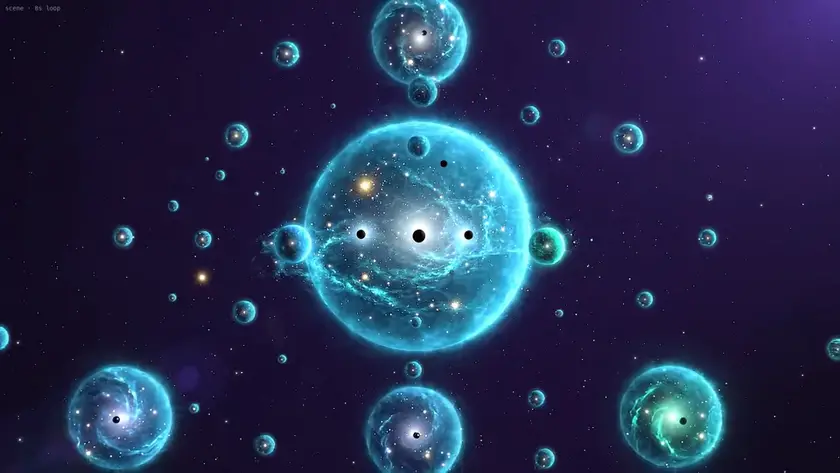
A scientific documentary visualization of Smolin's Cosmological Natural Selection. A single translucent cyan parent universe sits centered in the frame, containing internal cosmological structure (warm gold pinpoints for galaxies, faint cyan filaments for the cosmic web) and several visible dark points representing black holes within its volume. After two seconds, two of the black holes brighten and small child universes emerge from them, drifting outward into the surrounding space. Each child has slightly varied surface tints (blue-cyan, cyan-green) conveying mutated physical constants. The child universes themselves develop visible black holes that spawn grandchild universes at smaller scale by the final frames. The camera pulls back steadily throughout, revealing a populated lineage tree of universes at three scales. The visualization conveys the Darwinian claim that our universe descends from ancestors that were efficient at producing black holes, with each generation inheriting slightly varied physical constants.
- Family status
- Speculative
Basis: theoretical
Its one testable claim, that our constants maximise black-hole production, has no agreed test.
- Variant status
- Current
- Proposed
- 1992
- By
- Lee Smolin
- Reviewed
Citations per source
Also answers
Reader votes
No votes yet on this variant.
Vote if you find the argument convincing. One vote per network.
0 votes for this variant
4What would test it
4 predictions
- Our universe is near-optimal for black hole formation
- Small changes to any physical constant should reduce the number of black holes formed
- The mass distribution of stars in our universe is biased toward producing more black holes than a random distribution would
- Neutron stars should have a maximum mass near two solar masses, since a higher ceiling would let more of them collapse into black holes and change the predicted optimum
5Where it breaks
4 objections, plus 3 shared
- The "inheritance" mechanism (child universe inherits parent constants with mutation) is speculative and lacks derivation from fundamental physics
- Different choices of "selection criterion" give different answers; black hole production is one possible criterion among many
- Some specific predictions (e.g. about neutron star masses) have been contested by observation
- Critics argue the theory is unfalsifiable in practice because we can't observe other universes
Go deeper
Technical register
Stated precisely
Smolin proposed in 1992 that black holes give birth to new universes with mutated physical constants, producing a Darwinian process where our universe is fine-tuned not for life but for black hole production.
Smolin developed the proposal in his 1997 book 'The Life of the Cosmos' and in several technical papers. The key mechanism is that singularities inside black holes give rise to new expanding regions of spacetime (an idea going back to Pathria-Good and to John Wheeler's earlier speculation), and that quantum gravitational effects at the singularity could produce small random perturbations to physical constants.
The fine-tuning argument runs roughly as follows: the masses of fundamental particles and the strengths of forces determine which atomic nuclei are stable, which stars can form, and what their final masses are. Black hole formation requires sufficiently massive stars and sufficiently low metallicity in their progenitor gas clouds. Smolin argues that the observed values of physical constants are near a local maximum for black hole production rate.
Critics including Lawrence Krauss and Vilenkin have argued that the theory requires unobserved mechanisms (the inheritance process) and that its predictions about neutron star masses do not match observation. The debate continues; Smolin has updated the theory in response to specific objections.
Croon & Pinckney (2024) also show that CNS with this mechanism addresses the Boltzmann-brain problem on 10^14-year timescales, a long-standing objection to selection-based cosmologies.
- multiverse
- A picture in which our observable universe is one of many, possibly with different physical laws or constants.
- cosmological constant
- A constant energy density of empty space. In general relativity, it drives the accelerated expansion of the universe. Often written as Lambda.
- singularity
- A point in a theory where quantities like density become infinite, signaling the theory has broken down.
- spacetime
- The four-dimensional fabric combining the three dimensions of space with time, treated as one continuous structure.
6Who built it, and when
- 1
Smolin (1992). Did the Universe Evolve?
Class. Quantum Grav. 9, 173
established
no count, pre-arXiv
- 2
Smolin (1997). The Life of the Cosmos
Oxford University Press
established
no count, pre-arXiv
- 3
Smolin (2006). The Status of cosmological natural selection
arXiv:hep-th/0612185
established
25 citations
- 4
Bramante & Raj (2024). Cosmology of self-replicating universes in black holes formed by dark matter-seeded stellar collapse
Phys. Rev. D 110, 043537
needs verification
7 citations
Cosmological Selection, all 1 variant
Lead variant first, then by year
- Smolin's Cosmological Natural Selectionthis page1992
- Another answer to the same question: Eternal Inflation
Spotted an error? Have a source to add?
Prefer not to have your message stored?
Send it through the contact form instead, with the subject filled in. Contact messages are emailed, not stored.