Hawking Radiation (Original)
Black holes glow faintly, slowly leaking themselves into nothing.
- Family status
- Strongly supported
- Proposed
- 1974 and 1975
- Sources
- 7
- Reader votes
- 2
- Basis: theoretical
- Lab analogues reproduce the wave physics at a horizon, but no radiation from an astrophysical black hole has been detected.
1The claim
The 1974/1975 derivation that black holes radiate thermally at a temperature inversely proportional to their mass. With Bekenstein's 1973 entropy argument, the foundation of black hole thermodynamics.
2Why it might be true
Hawking's 1974 derivation starts from quantum field theory in curved spacetime: standard quantum mechanics, plus general relativity as a fixed background, no extra ingredients. Apply this to the region just outside a black hole's event horizon and the result is that the black hole emits a steady stream of particles, as if it were a hot body. The temperature is inversely proportional to the black hole's mass: a solar-mass black hole has a Hawking temperature of about 60 nanokelvin, far below the cosmic microwave background; the smallest primordial black holes evaporating today would be much hotter. The radiation is approximately thermal, with the exact spectrum modified by greybody factors arising from how curvature filters the outgoing modes.
The result vindicated Bekenstein. In 1973, building on the area theorems of classical general relativity and arguments about the second law of thermodynamics, Bekenstein proposed that black holes have entropy proportional to their horizon area: S equals A divided by four, in Planck units. The proposal was controversial because if black holes have entropy, they must have temperature, and if they have temperature they must radiate, which classical general relativity does not allow. Hawking's 1974 derivation showed that they DO radiate when quantum mechanics is included, at exactly the temperature that goes with Bekenstein's entropy. The combined Bekenstein-Hawking framework, area-proportional entropy plus mass-inverse temperature, is universally accepted as the leading-order picture of black hole thermodynamics.
Fifty years of follow-up work has refined the original derivation along several axes: corrections from greybody factors at non-zero angular momentum and charge, the trans-Planckian robustness question (whether the derivation depends on physics at energies above the Planck scale), the backreaction question (how the geometry responds to the radiation it emits), the unitarity question (whether information is preserved across the evaporation, which became the information paradox), and modifications predicted by each candidate quantum-gravity program. The 1974/1975 leading-order result is now universally accepted; the completeness questions remain active research more than half a century later.
3Evidence so far
- The Bekenstein-Hawking entropy formula has been reproduced from many independent angles: Euclidean path integral, brick wall, conical singularity, holographic, and string-theoretic microstate counting (Strominger-Vafa 1996); the convergence is non-trivial structural evidence
- The temperature-mass relation T proportional to 1/M is consistent with classical and semiclassical analyses, and is reproduced (with small modifications) in every candidate quantum-gravity program
- Lab analogs in water, optical fibers and atomic condensates reproduce the horizon effect Hawking derived. They test how waves behave at a horizon and cannot test gravity itself
- Calculations since 2019 reproduce the Page curve from gravity in simplified model universes. They show how information could escape, but they have not been extended to real black holes
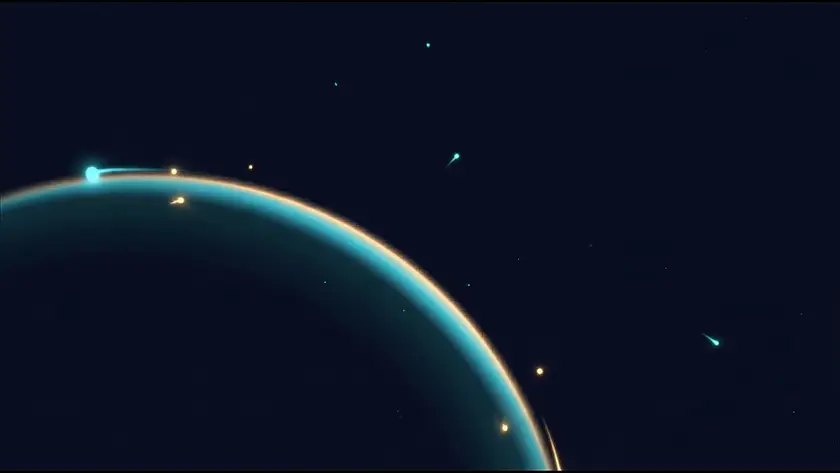
A scientific documentary visualization of Hawking radiation. A large dark translucent black hole event horizon fills the lower-left as a cropped curved edge, its rim catching soft cyan and warm-gold light, against an open deep indigo void. Along the rim, faint pairs of points appear: a cyan point drifts slowly outward into the void while its warm-gold partner crosses inward across the edge and vanishes, repeated quietly at scattered spots over the eight seconds, with a sparse scatter of escaped points drifting away by the end. The visualization conveys the variant's central claim that quantum mechanics near the horizon makes a black hole emit a steady faint stream of particles, slowly leaking itself into nothing, with no explosion and no accretion disk.
- Family status
- Strongly supported
Basis: theoretical
Lab analogues reproduce the wave physics at a horizon, but no radiation from an astrophysical black hole has been detected.
- Variant status
- Current
- Proposed
- 1974 and 1975
- By
- Stephen Hawking, Jacob Bekenstein
- Sources
- 7, all established
- Reviewed
Citations per source
None of the 7 sources has a stored citation count yet.
Reader votes
2 readers find this compelling.
Hawking Radiation has 2 votes so far. Rankings appear once a family has 20.
2 votes for this variant
4What would test it
4 predictions
- Black holes radiate at a temperature T inversely proportional to their mass M, so small black holes are hot and large ones are vanishingly cold; for astrophysical black holes the temperature is nanokelvin-scale, far below any detector sensitivity
- Black holes have entropy S equal to one quarter of their horizon area in Planck units; this is the Bekenstein-Hawking entropy and is the single most-confirmed prediction of the framework, reproduced from many independent angles
- The radiation spectrum is approximately thermal but modified by greybody factors that depend on the spin and charge of the black hole and the angular momentum of the outgoing mode
- A black hole left alone (no infalling matter) will eventually evaporate completely; for a solar-mass black hole the timescale is about 10^67 years, much longer than the current age of the universe
5Where it breaks
4 objections, plus 5 shared
- The original derivation treats the geometry as a fixed classical background; backreaction (how the geometry responds to the radiation) is included only perturbatively. Whether the result survives a full self-consistent treatment for old, heavily-evaporated black holes is an unsolved technical question
- The trans-Planckian problem (Jacobson 1991): Hawking's calculation traces outgoing modes back through the horizon, where they are blue-shifted past the Planck scale. Standard quantum field theory does not apply at those energies. The consensus has converged on 'robust against reasonable cutoffs' but the question is not formally closed
- Direct astrophysical observation has not happened in 50 years; for astrophysical black holes the temperature is far below any practical detection threshold; the only path to direct observation is through primordial black holes evaporating now, with no detection so far
- The exact end-stage of evaporation is unknown. As the black hole shrinks below the Planck mass, the semiclassical derivation breaks down, and the final stages depend on the (unknown) full theory of quantum gravity
Go deeper
Technical register
Stated precisely
Hawking showed in 1974 that quantum mechanics, applied to spacetime just outside a black hole's horizon, predicts a steady stream of particles leaking out as if the black hole were a hot object with a precise temperature. The result built on Bekenstein's 1973 entropy argument that black holes have entropy proportional to their horizon area, and pinned down the temperature that goes with that entropy. The Bekenstein-Hawking framework is the foundation of modern black hole thermodynamics.
Hawking temperature formula: T equals hbar times c cubed divided by (8 pi G M k_B). For a solar-mass black hole this gives T about 60 nanokelvin. For a black hole of mass M about 10^11 kg (a billion-billion grams) the temperature is GeV-scale, hot enough to produce particles much heavier than electrons; such black holes would be evaporating explosively today if they exist.
Bekenstein-Hawking entropy: S equals A divided by 4 in Planck units, where A is the horizon area. For a solar-mass Schwarzschild black hole the entropy is about 10^77 in dimensionless units, a value far larger than the thermodynamic entropy of any object of comparable size (a star has entropy about 10^58). The holographic interpretation is that all the entropy fits on a 2D surface.
Greybody factors: not all the thermal-spectrum modes emitted at the horizon escape to infinity. Some are reflected back by the curvature of spacetime outside the horizon. The reflection coefficient depends on the mode's angular momentum and the black hole's spin and charge, producing a spectrum that is not exactly Planckian but rather a thermal spectrum modulated by the greybody factor.
Connection to the second law: Bekenstein's original argument was that without black hole entropy, you could throw entropy across the horizon and violate the second law of thermodynamics. The generalized second law (Bekenstein 1973, refined by many) states that the sum of ordinary matter entropy and black hole entropy never decreases. This is now a foundational principle of black hole physics.
- general relativity
- Einstein's theory of gravity, in which mass and energy curve spacetime, and we experience that curvature as gravitational pull.
- event horizon
- The boundary around a black hole inside which nothing, not even light, can escape.
- cosmic microwave background
- The faint, uniform glow of light released about 380,000 years after the Big Bang, when the universe first became transparent.
- singularity
- A point in a theory where quantities like density become infinite, signaling the theory has broken down.
- quantum gravity
- Any theory that unifies general relativity with quantum mechanics. Needed to describe extreme conditions like black hole interiors and the Big Bang.
- spacetime
- The four-dimensional fabric combining the three dimensions of space with time, treated as one continuous structure.
- entropy
- A measure of disorder, equivalent to the number of microscopic arrangements consistent with what we see at large scales.
6Who built it, and when
- 1
Hawking (1974). Black hole explosions?
Nature 248, 30
established
no count, pre-arXiv
- 2
Hawking (1975). Particle Creation by Black Holes
Commun. Math. Phys. 43, 199
established
no count, pre-arXiv
- 3
Bekenstein (1973). Black holes and entropy
Phys. Rev. D 7, 2333
established
no count, pre-arXiv
- 4
Philbin et al. (2008). Fiber-optical analogue of the event horizon
Science 319, 1367
established
no count yet
- 5
Weinfurtner et al. (2011). Measurement of stimulated Hawking emission in an analogue system
Phys. Rev. Lett. 106, 021302
established
no count yet
- 6
Drori et al. (2019). Observation of Stimulated Hawking Radiation in Optics
Phys. Rev. Lett. 122, 010404
established
no count yet
- 7
Corley & Jacobson (1996). Hawking spectrum and high frequency dispersion
Phys. Rev. D 54, 1568
established
no count yet
Hawking Radiation, all 4 variants
Lead variant first, then by year
- Hawking Radiation (Original)this page1974 and 1975
- Primordial Black Hole Evaporation1974
- Analog Hawking Radiation and Trans-Planckian Concerns1981 and 1991 and 2016
- Hawking Radiation in Quantum Gravity Programs2000-2025
- Compare two variants
- Up next: Primordial Black Hole Evaporation
- Another answer to the same question: Black Hole Information Paradox
Spotted an error? Have a source to add?
Prefer not to have your message stored?
Send it through the contact form instead, with the subject filled in. Contact messages are emailed, not stored.