MOND, Original Phenomenological Law
Newton's law breaks at very low accelerations. Galaxies rotate as observed, no dark matter.
- Family status
- Frontier
- Proposed
- 1983
- Sources
- 10
- Reader votes
- 0
- Basis: observational
- The radial acceleration relation in galaxies is tight, but galaxy clusters and the Bullet Cluster need unseen mass.
1The claim
Newton's law breaks down at very low accelerations. Below a universal scale a_0 ≈ 10^-10 m/s², gravity is effectively stronger, and galaxies rotate as observed without dark matter.
2Why it might be true
MOND is not a relativistic theory, it's a modification of Newton's force law that kicks in below an acceleration scale a_0 ≈ 10^-10 m/s². Above a_0, gravity behaves exactly as Newton predicted. Below a_0, the force becomes effectively stronger, so an object orbiting at low velocity feels more gravity than a Newtonian calculation would predict. This effect is captured by a simple formula: in the deep-MOND regime, where the acceleration a is much smaller than a_0, the actual acceleration follows a ≈ sqrt(g_N · a_0), where g_N is the acceleration Newton's law would predict from the visible matter. This single rule fits galaxy rotation curves across enormous dynamical range, with one free parameter (a_0 fixed empirically once) and no free halo parameters per galaxy.
The galaxy-scale fit quality is exceptional. McGaugh, Lelli, and Schombert (2016, 2017) showed that around 150 galaxies in the SPARC database satisfy a tight relation between centripetal acceleration (from rotation velocity) and the Newtonian acceleration computed purely from baryonic matter, the radial acceleration relation. Scatter is consistent with observational error; the intrinsic scatter is consistent with zero. Whether MOND is the right underlying theory or not, this empirical regularity is real and is not yet derived from first principles within ΛCDM, where it must emerge from baryonic feedback in N-body simulations.
MOND captures a real galaxy-scale empirical pattern that any successful theory of the dark sector must explain, but it faces problems at cluster and cosmological scales. At cluster scales, the Bullet Cluster (Clowe et al 2006) shows lensing mass cleanly separated from baryonic gas in a way MOND alone cannot explain without invoking some additional dark component. And the CMB acoustic-peak structure is reproduced precisely by ΛCDM with cold dark matter; relativistic MOND extensions struggle here. Wide-binary tests using Gaia DR3 are an active empirical question right now: the joint Banik-Pittordis-Sutherland 2024 analysis sets strong constraints, with some sub-analyses favoring standard gravity over MOND and others leaving more room for a MOND-like signal.
3Evidence so far
- McGaugh, Lelli & Schombert 2016 (PRL 117) measured the radial acceleration relation in ~150 SPARC galaxies; scatter is consistent with observational error, no per-galaxy free parameters needed
- Lelli, McGaugh, Schombert & Pawlowski 2017 (ApJ 836), 'One Law to Rule Them All,' extended the analysis and found the relation holds across diverse galaxy types
- Baryonic Tully-Fisher relation matches MOND prediction across roughly four decades in baryonic mass
- Banik, Pittordis, Sutherland and collaborators 2024 (a joint analysis of widely separated binary stars from the Gaia DR3 catalogue) measured how those stars orbit in the very low gravity where MOND should deviate from Newton; the results remain debated, with some sub-analyses suggesting standard gravity is favored and others leaving room for a MOND-like signal
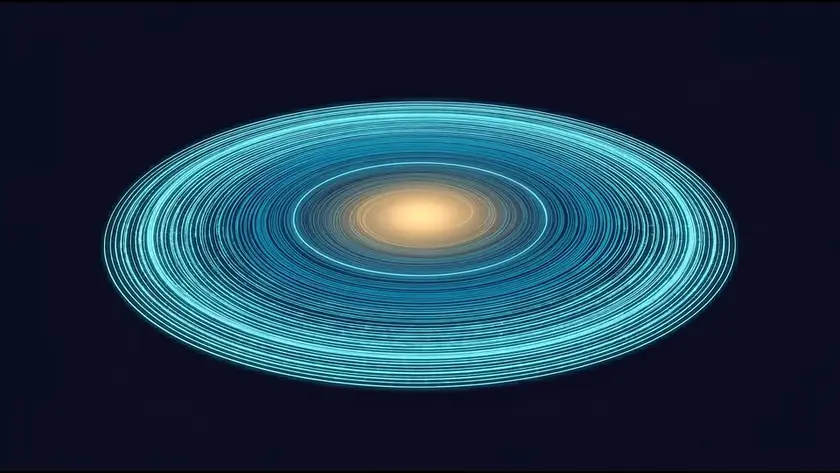
A spiral galaxy of even concentric orbital streamlines rotating as one flat-curve system, with a single glowing transition ring and no surrounding dark-matter halo, Milgrom's modified-gravity law.
- Family status
- Frontier
Basis: observational
The radial acceleration relation in galaxies is tight, but galaxy clusters and the Bullet Cluster need unseen mass.
- Variant status
- Current
- Proposed
- 1983
- By
- Mordehai Milgrom, Stacy McGaugh, Federico Lelli
- Sources
- 10: 8 established, 2 debated
- Reviewed
Citations per source
Reader votes
No votes yet on this variant.
Vote if you find the argument convincing. One vote per network.
0 votes for this variant
4What would test it
3 predictions
- Radial acceleration relation: in every galaxy, how fast stars actually accelerate as they orbit is fixed by how much visible matter is present. The observed centripetal acceleration (the inward pull that keeps an orbit curving) tracks the Newtonian acceleration predicted from baryonic matter (ordinary stars and gas) through one universal scale a_0, with no separate dark-halo parameter tuned per galaxy
- The baryonic Tully-Fisher relation: a spinning galaxy's flat rotation speed to the fourth power tracks its visible (baryonic) mass, V^4 ∝ M_baryon · a_0, with none of the scatter you would expect if dark-halo properties varied, because in MOND there is no halo
- Wide binaries at separations above ~10^4 AU have orbital velocities probing the deep-MOND regime; specific Newton-Kepler deviations are predicted
5Where it breaks
5 objections, plus 4 shared
- Clowe et al 2006 Bullet Cluster: weak-lensing mass is spatially separated from baryonic gas after a cluster collision, requiring some dark component beyond what MOND alone provides
- CMB acoustic-peak structure is fit precisely by ΛCDM with cold dark matter; no MOND-derived cosmological framework reproduces the CMB without invoking some particle-like dark component
- Pittordis & Sutherland 2022 wide-binary analysis using Gaia EDR3 found a preference for GR over MOND, contradicting earlier claims of MOND-like tension; subsequent analyses are ongoing
- Galaxy cluster dynamics (X-ray temperature profiles, lensing mass) require more mass than baryons alone, even in MOND, undercutting the 'no dark matter' motivation at cluster scales
- MOND has no fundamental motivation: a_0 is fit empirically, not derived from first principles, and the interpolating function between Newtonian and deep-MOND regimes is also free-form
Go deeper
Technical register
Stated precisely
Milgrom proposed in 1983 that Newton's law of gravity breaks down at extremely low accelerations, below a universal scale a_0 ≈ 10^-10 m/s². Below this scale, gravity effectively gets stronger than Newton predicts, and galaxies rotate as observed without invoking dark matter.
MOND interpolating function: a · μ(a / a_0) = g_N, where g_N is the Newtonian acceleration computed from visible matter and μ is a smooth function with μ(x) -> 1 for x >> 1 and μ(x) -> x for x << 1. The deep-MOND limit gives a = sqrt(g_N · a_0). The value a_0 ≈ 1.2 × 10^-10 m/s² is fit to galaxy data; it is approximately c · H_0 (the speed of light times the Hubble parameter), which is suggestive but not derived.
Radial acceleration relation form: g_obs = g_bar / (1 - exp(-sqrt(g_bar / a_0))), as proposed by McGaugh-Lelli-Schombert 2016. This form was extracted directly from observational data rather than derived from first principles.
Cluster scales: in MOND, cluster dynamics require additional unseen mass even with the modified law (often invoked as hot neutrinos or hot dark matter at cluster scales, which would still leave galaxy-scale MOND intact). This hybrid approach, MOND for galaxies and dark matter for clusters, lacks theoretical motivation and is not adopted in mainstream work.
Wide-binary parameter space: Gaia DR3 wide binaries with separations 10^4 to 10^5 AU and orbital periods 10^5 to 10^6 yr probe the deep-MOND regime. The expected MOND deviation from Newton-Kepler is detectable if a_0 is universal, but the analysis depends critically on excluding hierarchical (triple) systems where a third star contaminates the dynamics. The Banik-Pittordis-Sutherland 2024 joint paper is the current authoritative analysis; Pittordis-Sutherland-Shepherd 2025 added triple-modelling refinements.
- dark matter
- A form of matter that interacts gravitationally but emits no light, making up about 27 percent of the universe.
6Who built it, and when
- 1
Milgrom (1983). A modification of the Newtonian dynamics as a possible alternative to the hidden mass hypothesis
Astrophys. J. 270, 365
established
no count, pre-arXiv
- 2
Milgrom (2009). Bimetric MOND gravity
Phys. Rev. D 80, 123536
established
221 citations
- 3
Milgrom (2010). Quasi-linear formulation of MOND
Mon. Not. Roy. Astron. Soc. 403, 886
established
223 citations
- 4
Milgrom (2015). MOND theory
Can. J. Phys. 93, 107
established
178 citations
- 5
McGaugh et al. (2016). Radial Acceleration Relation in Rotationally Supported Galaxies
Phys. Rev. Lett. 117, 201101
established
535 citations
- 6
Lelli et al. (2017). One Law to Rule Them All: The Radial Acceleration Relation of Galaxies
Astrophys. J. 836, 152
established
367 citations
- 7
Pittordis & Sutherland (2022). Wide Binaries from GAIA EDR3: preference for GR over MOND?
arXiv:2205.02846
debated
28 citations
- 8
Banik et al. (2024). Strong constraints on the gravitational law from Gaia DR3 wide binaries
Mon. Not. Roy. Astron. Soc. 527, 4573
debated
69 citations
- 9
Desmond (2025). Modified Newtonian Dynamics: Observational Successes and Failures
arXiv:2505.21638
established
9 citations
- 10
Clowe et al. (2006). A direct empirical proof of the existence of dark matter
Astrophys. J. 648, L109
established
no count yet
Modified Gravity / MOND, all 4 variants
Lead variant first, then by year
- MOND, Original Phenomenological Lawthis page1983
- TeVeS (Tensor-Vector-Scalar)2004
- Moffat MOG (Scalar-Tensor-Vector Gravity)2006
- Skordis-Złośnik Aether Scalar-Tensor2021
- Compare two variants
- Up next: TeVeS (Tensor-Vector-Scalar)
- Another answer to the same question: Standard Cosmological Model
Spotted an error? Have a source to add?
Prefer not to have your message stored?
Send it through the contact form instead, with the subject filled in. Contact messages are emailed, not stored.