Superstring Theory
Particles are tiny vibrating strings. Gravity falls out for free.
- Family status
- Frontier
- Proposed
- 1984
- Sources
- 5
- Reader votes
- 0
- Basis: theoretical
- Anomaly cancellation, black-hole entropy counting and dualities support it, but no prediction distinctive to string theory has been confirmed.
1The claim
All particles as vibrating strings in 10 dimensions, with supersymmetry pairing matter and forces. A spin-2 graviton mode makes gravity automatic. Mathematically consistent since the 1984 Green-Schwarz anomaly cancellation.
2Why it might be true
Superstring theory's central move is to replace the points of quantum field theory with one-dimensional vibrating strings. A single kind of string can vibrate in many different ways, and each vibrational mode acts in 4D physics like a different particle. One of the lowest-energy vibrational modes is a massless spin-2 mode, which is exactly what a graviton has to be, so gravity comes out of the framework automatically rather than being put in by hand. Adding fermions (matter particles like electrons and quarks) to the spectrum requires supersymmetry, a proposed symmetry that pairs each force-carrying boson with a matter-carrying fermion. The combination of strings plus supersymmetry forces the spacetime dimension to be 10 for the math to be consistent.
The 1970s bosonic string theory was the precursor: 26 spacetime dimensions, no fermions, and an instability called a tachyon. It was foundational conceptually but not a realistic candidate for the world we observe; today it lives mostly in textbooks as the warm-up problem. The five 10-dimensional superstring theories worked out in the early 1980s (Type I, Type IIA, Type IIB, heterotic SO(32), heterotic E8 x E8) were the first internally consistent versions that could include fermions, and the 1984 Green-Schwarz anomaly cancellation showed that gauge anomalies in 10D actually cancel for SO(32) (and later for E8 x E8 heterotic). That cancellation was the moment the field went from speculative to serious.
Direct empirical contact has been the standing problem ever since. Distinctive string effects show up at the Planck scale, around 10^19 GeV, which is roughly 10^15 times above what colliders can currently probe. The defenders argue that the framework's internal results, exact black-hole entropy from microstate counting, holographic dualities like AdS/CFT, and a network of dualities relating apparently distinct theories, are evidence of real physical structure even without direct experiments. The critics argue that this is a research program in lieu of a theory and that 40 years without a unique low-energy prediction is a fact, not a phase. Both views are honestly held within the physics community.
3Evidence so far
- Anomaly cancellation: Green-Schwarz showed in 1984 that the 10D gauge and gravitational anomalies cancel non-trivially for SO(32), and later work extended this to E8 x E8 heterotic; this is a strong internal-consistency result
- Black-hole microstate counting: Strominger and Vafa 1996 derived the Bekenstein-Hawking entropy of certain extremal black holes from string-theoretic microstate counting, giving exact agreement with the semiclassical formula
- AdS/CFT correspondence: Maldacena's 1997 conjecture relating string theory in anti-de Sitter space to gauge theory on its boundary has produced thousands of cross-checks and is now standard machinery in formal high-energy theory and condensed matter
- Mathematical structure: dualities relating the five 10D theories plus M-theory, integrability of scattering amplitudes, and connections to algebraic geometry have repeatedly turned out to be internally consistent in ways that look surprising if string theory had no physical content
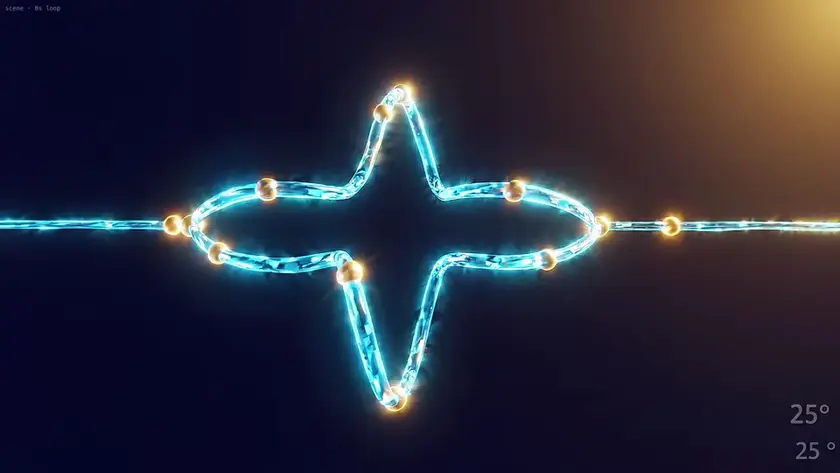
A single vibrating string, each vibrational mode a different particle
A single luminous cyan closed string loop vibrates in a multi-antinode standing-wave mode with warm gold nodes at points of maximum curvature, representing different vibrational modes appearing as distinct particles including a massless spin-2 graviton.
- Family status
- Frontier
Basis: theoretical
Anomaly cancellation, black-hole entropy counting and dualities support it, but no prediction distinctive to string theory has been confirmed.
- Variant status
- Current
- Proposed
- 1984
- By
- Michael Green, John Schwarz, Edward Witten
- Sources
- 5, all established
- Reviewed
Citations per source
Reader votes
No votes yet on this variant.
Vote if you find the argument convincing. One vote per network.
0 votes for this variant
4What would test it
4 predictions
- A massless spin-2 graviton mode is automatic in the string spectrum, recovering general relativity at long distances without additional assumptions
- Gauge anomalies in 10D cancel for SO(32) and E8 x E8 gauge groups, picking out the heterotic and Type I theories as anomaly-free (Green-Schwarz 1984)
- Specific patterns of scattering amplitudes deviate from quantum field theory at energies approaching the string scale; the deviations are calculable but the energies are inaccessible to current colliders
- Standard-Model-like spectra (gauge groups, chiral fermions, three generations) can be derived from specific compactifications of the extra dimensions; the derivation is non-unique and depends on the chosen Calabi-Yau or F-theory geometry
5Where it breaks
4 objections, plus 4 shared
- The LHC has produced no evidence for supersymmetric partners through Run 3, pushing the natural-SUSY string phenomenology into fine-tuned regions and undermining the simplest WIMP-style relic-abundance arguments that motivated low-scale SUSY
- Direct empirical contact: no distinctive low-energy prediction has been confirmed in 40 years; specific stringy signatures live at Planck energies inaccessible to current and foreseeable experiments
- Vacuum non-uniqueness: even within superstring theory itself, the choice of compactification is enormous and no selection principle picks out our Standard-Model-like physics uniquely
- Critics (Smolin, Woit, Hossenfelder among others) charge that the field has not produced testable predictions and that sociological factors, not empirical success, are keeping it dominant; the field treats this charge as a serious tension rather than a settled refutation
Go deeper
Technical register
Stated precisely
Tiny one-dimensional vibrating strings replace point particles. Different vibrational modes appear as different particles and forces, including a spin-2 graviton. To be mathematically consistent the strings live in 10 spacetime dimensions and obey supersymmetry. The 1984 Green-Schwarz anomaly cancellation put the framework on the map as a serious candidate for a theory of everything.
The five 10D superstring theories differ in their gauge groups and orientability: Type I is unoriented with SO(32) gauge group; Type IIA and Type IIB are oriented with no perturbative gauge group; heterotic SO(32) and heterotic E8 x E8 are oriented with the indicated gauge groups built in. Dualities (S-duality, T-duality, U-duality) relate them pairwise.
Green-Schwarz mechanism: the 10D gauge anomaly is cancelled by a one-loop contribution from a 2-form gauge field with a specific anomalous transformation. The mechanism only works for gauge groups whose anomaly coefficients factorise correctly, which singles out SO(32) and E8 x E8.
Critical dimension: bosonic strings require D = 26 for Weyl invariance to survive quantisation; superstrings require D = 10. This is not an input but a consistency requirement on the worldsheet quantum field theory.
Worldsheet vs target-space: the 2D worldsheet of the string is a conformal field theory with central charge fixed by the spacetime dimension. The 10D target spacetime is where particles and fields live; the worldsheet is the auxiliary 2D theory used to compute string amplitudes.
- string theory
- A framework proposing that fundamental particles are tiny vibrating strings rather than points, requiring extra dimensions of space.
- entropy
- A measure of disorder, equivalent to the number of microscopic arrangements consistent with what we see at large scales.
- general relativity
- Einstein's theory of gravity, in which mass and energy curve spacetime, and we experience that curvature as gravitational pull.
- spacetime
- The four-dimensional fabric combining the three dimensions of space with time, treated as one continuous structure.
6Who built it, and when
- 1
Green & Schwarz (1984). Anomaly Cancellation in Supersymmetric D = 10 Gauge Theory and Superstring Theory
Phys. Lett. B 149, 117
established
no count, pre-arXiv
- 2
Strominger & Vafa (1996). Microscopic Origin of the Bekenstein-Hawking Entropy
Phys. Lett. B 379, 99
established
3,895 citations
- 3
Maldacena (1998). The Large N Limit of Superconformal Field Theories and Supergravity
Adv. Theor. Math. Phys. 2, 231
established
22,691 citations
- 4
Agmon et al. (2022). Lectures on the string landscape and the Swampland
arXiv:2212.06187
established
297 citations
- 5
ATLAS Collaboration (2025). The quest to discover supersymmetry at the ATLAS experiment
Phys. Rep. 1116, 261
established
no count yet
String Theory, all 5 variants
Lead variant first, then by year
- Superstring Theorythis page1984
- Heterotic Compactifications1985
- M-Theory1995
- F-Theory1996
- Swampland Program2005
- Compare two variants
- Up next: Heterotic Compactifications
- Another answer to the same question: Beneath the Standard Model
Spotted an error? Have a source to add?
Prefer not to have your message stored?
Send it through the contact form instead, with the subject filled in. Contact messages are emailed, not stored.