Janus Universe
The Bang is a mirror. Time runs forward here, backward in a twin universe.
- Family status
- Speculative
- Proposed
- 2018
- Sources
- 2
- Reader votes
- 0
- Basis: theoretical
- Only the CPT variant's curvature prediction has been compared with data, which it fits without confirming.
1The claim
The Big Bang is a mirror point. Time flows in one direction for us; in the opposite direction in a mirror universe.
2Why it might be true
The Janus model is named after the Roman god with two faces, looking forward and backward simultaneously. The Big Bang, in this picture, is not a beginning but a 'Janus point' from which two universes emerge, evolving in opposite temporal directions. Our universe expands away from the Janus point into our future. The mirror universe expands away from the Janus point in the opposite direction, into what we would call 'before' but what its inhabitants experience as their future.
This solves a longstanding puzzle in physics: why does time appear to have a preferred direction (an 'arrow of time') when the fundamental laws of physics are time-symmetric? The Janus answer: the laws ARE time-symmetric, and what we call the arrow of time is just the direction away from the Janus point. Observers in the mirror universe see time flowing in their direction with the same conviction we have about ours.
Julian Barbour and his collaborators developed this from work on shape dynamics, an alternative formulation of general relativity. Their model is mathematical and concerned with how to describe a universe whose geometry doesn't include a preferred time direction. The result is that the Big Bang naturally has two evolving sides.
3Evidence so far
- Mathematically elegant solution to the arrow of time problem
- Removes the need for fine-tuned initial conditions to explain low initial entropy
- Consistent with general relativity
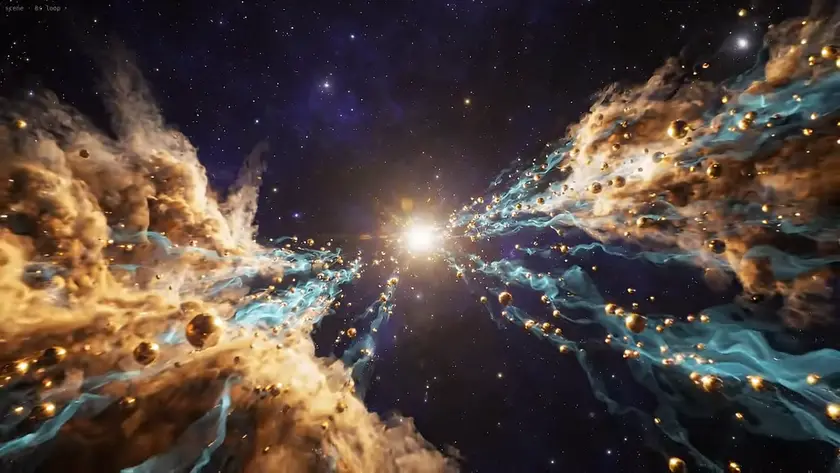
A scientific documentary visualization of the Time-Symmetric Cosmologies family. A brilliant central focal point of warm white-gold light anchors the composition, the singular pivot from which two large fan-shaped expanding regions emerge along a diagonal axis. Each fan is a softly billowing cloud of warm golden matter points threaded with translucent cyan filaments, and the two fans are mirror-symmetric to each other around the central pivot. Matter and filaments drift slowly outward from the pivot in opposite directions along the diagonal. The camera dollies back smoothly across eight seconds, widening the view to reveal the full symmetric structure. The visualization conveys the family's central claim that the universe is time-symmetric around a cosmological pivot, with no privileged direction of time at the fundamental level.
- Family status
- Speculative
Basis: theoretical
Only the CPT variant's curvature prediction has been compared with data, which it fits without confirming.
- Variant status
- Current
- Proposed
- 2018
- By
- Julian Barbour, Tim Koslowski, Flavio Mercati
- Sources
- 2, all established
- Reviewed
Citations per source
Reader votes
No votes yet on this variant.
Vote if you find the argument convincing. One vote per network.
0 votes for this variant
4What would test it
4 predictions
- A mirror universe exists with reversed time arrow relative to ours
- Entropy increases from the Janus point in both directions, never inversely
- No direct observational signatures from the mirror universe (it's causally disconnected from us)
- The arrow of time arises naturally from cosmic geometry rather than from special initial conditions
5Where it breaks
4 objections, plus 3 shared
- No direct observational test possible
- Other approaches to the arrow of time (statistical thermodynamics, decoherence) don't require a mirror universe
- The mirror universe is undetectable by definition
- Some critics argue the mathematics is more complicated than necessary
Go deeper
Technical register
Stated precisely
Barbour and collaborators proposed in 2018 that the Big Bang is the central point of two universes, with time flowing forward into ours and backward into a mirror universe that we can never directly observe.
Barbour, Koslowski, and Mercati formulate the model in terms of shape dynamics, a reformulation of general relativity that focuses on the intrinsic geometry of space rather than spacetime. In their formalism, the universe naturally has two solutions emerging from a common 'shape configuration' at the Big Bang.
The mathematical setup involves the gravitational N-body problem, where it can be shown that under certain conditions, all solutions tend to a 'Janus point' of maximum simplicity. The two halves of the solution are time-reverses of each other.
The proposal is closely related to longstanding debates about the foundations of statistical mechanics. The 'past hypothesis' (the idea that the universe started in a low-entropy state) is essentially the foundation of the arrow of time. The Janus model replaces the past hypothesis with a 'midpoint hypothesis' that may be more physically natural.
The name 'Janus' has also been used by Jean-Pierre Petit for a distinct bimetric gravity framework. The two proposals share the name but are mathematically and conceptually unrelated.
- general relativity
- Einstein's theory of gravity, in which mass and energy curve spacetime, and we experience that curvature as gravitational pull.
- entropy
- A measure of disorder, equivalent to the number of microscopic arrangements consistent with what we see at large scales.
- spacetime
- The four-dimensional fabric combining the three dimensions of space with time, treated as one continuous structure.
6Who built it, and when
- 1
Barbour et al. (2014). Identification of a gravitational arrow of time
Phys. Rev. Lett. 113, 181101
established
97 citations
- 2
Barbour (2020). The Janus Point: A New Theory of Time
Basic Books
established
no count, pre-arXiv
Time-Symmetric Cosmologies, all 2 variants
Lead variant first, then by year
- Janus Universethis page2018
- Boyle-Turok CPT-Symmetric Universe2021 and 2024
- Compare two variants
- Up next: Boyle-Turok CPT-Symmetric Universe
- Another answer to the same question: Eternal Inflation
Spotted an error? Have a source to add?
Prefer not to have your message stored?
Send it through the contact form instead, with the subject filled in. Contact messages are emailed, not stored.