Hypergraph Rewriting Model
Apply simple rules to a graph, again and again. Spacetime emerges from the result.
- Family status
- Fringe
- Proposed
- 2020
- Sources
- 2
- Reader votes
- 0
- Basis: theoretical
- The work appears mainly in Wolfram's own venues, its derivations are structural analogies, and no testable prediction has emerged.
1The claim
The founding proposal. Iterated application of a simple rule to a hypergraph produces a causal network whose large-scale limit behaves like a Lorentzian spacetime and whose geodesic ball growth encodes the Ricci curvature term in the Einstein equations.
2Why it might be true
A hypergraph is an abstract mathematical structure more general than an ordinary graph: its edges can connect more than two nodes simultaneously. The Wolfram Physics Project takes a hypergraph as the fundamental substrate and posits that the laws of physics are a rewriting rule, a substitution that replaces one local pattern of hyperedges with another. No background geometry, no spacetime, no quantum fields: just abstract elements being relabeled and reconnected according to the rule. Space, time, and matter are claimed to emerge from the accumulated causal structure of all the rule applications.
The key technical concept is causal invariance: if all orderings of rule applications produce the same causal graph, the same record of which events causally precede which, the system is causal invariant. Wolfram and Gorard argue that causal invariance implies both relativistic covariance and aspects of quantum mechanics. For the gravitational claim: the causal graph defines a Lorentzian causal structure, and for causal-invariant rules, the continuum limit of geodesic ball volume growth reproduces the Ricci curvature formula appearing in the Einstein equations. The claim is that general relativity is not postulated but derived.
The April 2020 technical introduction, hosted on wolframphysics.org, is a book-length document surveying hundreds of simple rules, showing which ones produce hypergraphs with interesting causal structures, and presenting the heuristic derivation of Einstein-like equations and quantum-mechanics-like behavior. The project has attracted a small number of contributors and maintains an active publication record on its own infrastructure, with Gorard taking on most of the technical derivations. Limited peer review from the broader theoretical physics community remains the project's most significant credibility constraint.
3Evidence so far
- For specific simple rules, geodesic ball growth in the resulting causal graph does exhibit the scaling behavior expected from the Ricci curvature term in the Einstein equations, at the level of a structural analogy in low-dimensional examples
- The multiway-graph branching structure has been shown to satisfy a form of the path integral superposition principle in simple model systems, as developed in the quantum mechanics variant
- Gorard's companion paper arXiv:2004.14810 derives the Schwarzschild metric and event horizon location for specific rule classes, providing a more quantitative connection to known general relativistic solutions
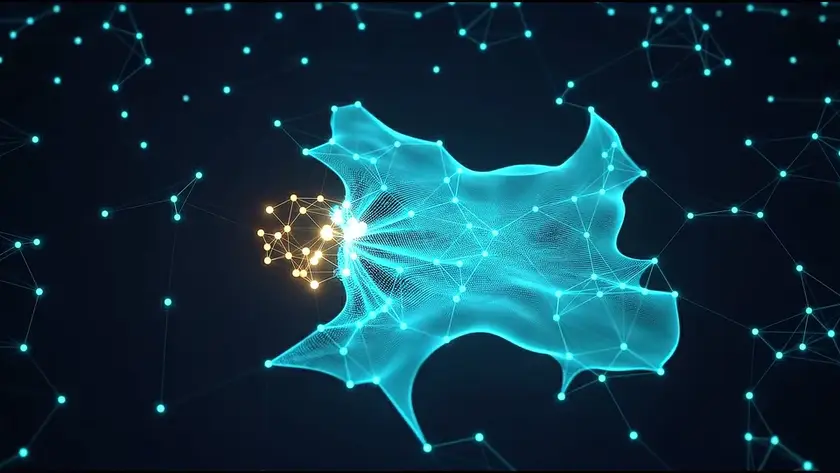
A scientific documentary visualization of the Wolfram model. A network of cyan nodes and links fills deep indigo space, and a small warm-gold cluster, the active rewrite site, repeatedly updates and knits the network outward into a continuous glowing cyan mesh. The visualization conveys the central claim that space is a vast hypergraph and that a simple local rewrite rule, applied over and over, grows and reshapes it until smooth spacetime emerges.
- Family status
- Fringe
Basis: theoretical
The work appears mainly in Wolfram's own venues, its derivations are structural analogies, and no testable prediction has emerged.
- Variant status
- Current
- Proposed
- 2020
- By
- Stephen Wolfram, Jonathan Gorard
- Reviewed
Citations per source
None of the 2 sources has a stored citation count. All predate arXiv.
Reader votes
No votes yet on this variant.
Vote if you find the argument convincing. One vote per network.
0 votes for this variant
4What would test it
4 predictions
- For causal-invariant hypergraph rules, the large-scale continuum limit of the causal graph satisfies equations resembling the Einstein field equations, with spacetime curvature determined by the local density of hyperedges
- The speed of light corresponds to a specific maximum rate of hyperedge propagation in the hypergraph and is a derived quantity rather than a postulate
- If the correct rule governing our universe can be identified, all particle masses, coupling constants, and other physical parameters follow from the combinatorics of that rule
- Causal invariance of the rewriting system is a necessary condition for relativistic invariance; violations of causal invariance would produce observable Lorentz-violating signatures in high-energy particle physics
5Where it breaks
3 objections, plus 4 shared
- The claimed derivation of the Einstein equations is a structural analogy, not a precision derivation: the correspondence between geodesic growth in the causal graph and Ricci curvature has been demonstrated for simple low-dimensional examples but not in the general four-dimensional Lorentzian setting that GR requires
- No rule governing our universe has been identified; without it, the project produces a framework with no specific quantitative predictions
- The project's technical publications are on its own website rather than in mainstream peer-reviewed physics journals, limiting the independent scrutiny they have received
Go deeper
Technical register
Stated precisely
Wolfram and Gorard's 2020 technical introduction showed that certain hypergraph rewriting rules, applied iteratively, produce a causal network with properties resembling Lorentzian spacetime, and that the growth law of geodesic balls in the resulting graph matches the Ricci curvature term in the Einstein equations to leading order.
Causal invariance: a rewriting system is causal invariant if any sequence of rule applications eventually produces the same causal graph, regardless of the order in which non-overlapping rule instances are applied. Church-Rosser confluence in lambda calculus is the same concept. Causal invariance is Wolfram's proposed origin of Lorentz invariance: observers disagreeing on the order of spacelike-separated events are making different but equivalent orderings of the rule applications.
Geodesic ball volume and Ricci curvature: in a Riemannian manifold, the volume of a geodesic ball of radius epsilon around a point p deviates from flat-space growth by a term proportional to the Ricci scalar at p and epsilon squared. Wolfram and Gorard propose that the same expansion holds for geodesic balls in the causal graph, with the deviation from flat growth encoding the curvature and hence the energy-momentum content via the Einstein equations.
Comparison with causal set theory: causal set theory (Bombelli, Lee, Meyer, Sorkin 1987) also discretizes spacetime using a partial order and derives Lorentzian geometry from the causal structure, with a specific sprinkle measure relating the discrete to the continuum. The key difference is that causal set theory is an approach to quantizing a background spacetime, while the Wolfram project claims to derive even the topology of spacetime from the rule. The formal connection between the two frameworks has not been established.
Quantum mechanics from the multiway graph: each rewriting rule may apply to multiple overlapping patterns simultaneously, producing multiple branches. The multiway system tracks all branches. Gorard's derivation of quantum-mechanics-like behavior uses the causal graph of the multiway system, where interference corresponds to convergence of branches. The analogy to Feynman path integrals is structural: branches play the role of paths, and interference corresponds to two branches having the same endpoint in the branchial graph.
- general relativity
- Einstein's theory of gravity, in which mass and energy curve spacetime, and we experience that curvature as gravitational pull.
- quantum gravity
- Any theory that unifies general relativity with quantum mechanics. Needed to describe extreme conditions like black hole interiors and the Big Bang.
6Who built it, and when
- 1
Wolfram (2020). A Project to Find the Fundamental Theory of Physics
Wolfram Media
needs verification
no count, pre-arXiv
- 2
Becker (2020). Physicists Criticize Stephen Wolfram's "Theory of Everything"
Scientific American, 6 May 2020
established
no count, pre-arXiv
Wolfram Physics Project, all 3 variants
Lead variant first, then by year
- Hypergraph Rewriting Modelthis page2020
- Multiway Systems and Quantum Mechanics2020
- Relativistic and Gravitational Properties2020
- Compare two variants
- Up next: Multiway Systems and Quantum Mechanics
- Another answer to the same question: Beneath the Standard Model
Spotted an error? Have a source to add?
Prefer not to have your message stored?
Send it through the contact form instead, with the subject filled in. Contact messages are emailed, not stored.