Everettian Quantum Cosmology
Every quantum outcome actually happens. Each one carves off its own universe.
- Family status
- Speculative
- Proposed
- 1957
- Sources
- 3
- Reader votes
- 0
- Basis: theoretical
- Both positions are partly philosophical, and neither has yet produced a prediction that an observation could check.
1The claim
The cosmological wavefunction never collapses. Every possible universe is real, branching off at every quantum event.
2Why it might be true
The Everett 1957 interpretation of quantum mechanics holds that quantum branching is real: when a quantum measurement could yield multiple outcomes, all of them actually occur, in parallel branches of the universal wavefunction. Applied to cosmology, this means our universe is one branch of a vastly larger wavefunction containing all possible universes.
There are two very different kinds of multiverse, and it helps to keep them apart. One kind is built from space: distant regions you could in principle travel toward. The other kind, the one meant here, is built from quantum possibility: parallel versions of reality that split off at every quantum event. So the 'multiverse' here is not the bubble-universe multiverse of eternal inflation (spatially separated regions of one spacetime) but the branching-quantum multiverse, the universal wavefunction carrying different terms for different histories. Every quantum event splits the universe; every choice you didn't make is being made in a parallel branch.
David Deutsch has been particularly forceful in arguing that the Everettian interpretation should be taken seriously as a cosmological framework, not just as a theory of measurement. In his view, this is the natural cosmological framework if quantum mechanics is universally correct. The 'before' of our universe is the larger wavefunction from which our particular branch emerged.
3Evidence so far
- Consistent with standard quantum mechanics, without invoking wavefunction collapse
- Resolves the measurement problem (how a definite outcome emerges from quantum randomness) without adding new physics
- Has accumulated philosophical support since the 1970s
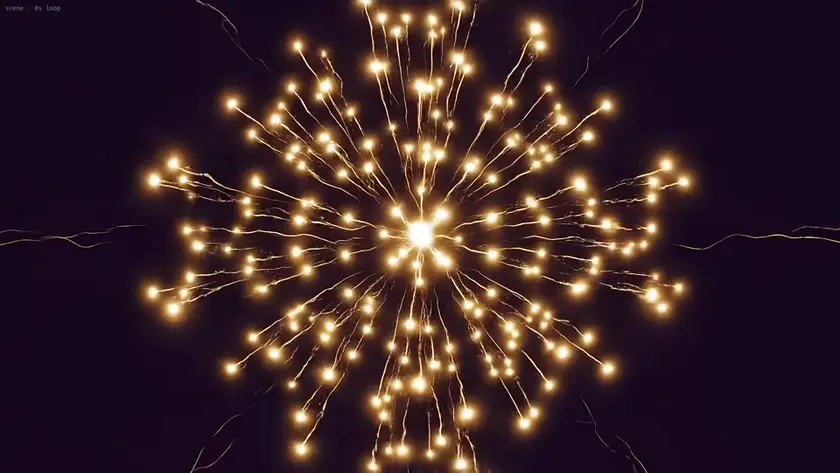
A scientific documentary visualization of Everettian Quantum Cosmology. A single warm-gold luminous point at the centre of deep indigo space bifurcates repeatedly over eight seconds, splitting into eight radial filaments, then each filament splitting again and again, until a delicate radial fractal of hundreds of warm-gold filaments and pinpoints fills the frame. Every branch persists; none fade. The visualization conveys the central claim of the Everettian interpretation applied to cosmology: every quantum event splits the universe, and all branches are equally real, producing a vast fractal of coexisting universes that all trace back to a single common origin.
- Family status
- Speculative
Basis: theoretical
Both positions are partly philosophical, and neither has yet produced a prediction that an observation could check.
- Variant status
- Current
- Proposed
- 1957
- By
- Hugh Everett III, David Deutsch
- Sources
- 3, all established
- Reviewed
Citations per source
None of the 3 sources has a stored citation count. All predate arXiv.
Reader votes
No votes yet on this variant.
Vote if you find the argument convincing. One vote per network.
0 votes for this variant
4What would test it
4 predictions
- Quantum mechanics applies to the universe as a whole
- All possible universes exist as branches of the wavefunction
- Because branching is treated as physically real rather than a bookkeeping device, no experiment should ever reveal a genuine wavefunction collapse or a preferred outcome; quantum interference should persist at every scale we can probe, in contrast to collapse-based rivals that predict a breakdown
- No 'preferred' branch; our experience is just the appearance from inside one branch
5Where it breaks
4 objections, plus 3 shared
- Most physicists view the proliferation of universes as ontologically extravagant
- No way to test that the other branches exist
- The probability rule of quantum mechanics is harder to derive in many-worlds than in collapse-based interpretations
- Some physicists (notably Penrose, Vilenkin) argue the framework is unfalsifiable
Go deeper
Technical register
Stated precisely
Everettian Quantum Cosmology applies the Everettian interpretation of quantum mechanics to the universe as a whole: every quantum branching produces a real universe.
Hugh Everett's 1957 PhD dissertation introduced the relative-state formulation of quantum mechanics, which proposed that quantum branching is real. Bryce DeWitt elaborated and popularized this in the 1960s and 1970s as the 'many-worlds interpretation.'
The cosmological application is straightforward: if quantum mechanics applies to the universe as a whole, then the universal wavefunction contains all possible cosmological histories. Our observed universe is just one branch of this wavefunction, corresponding to a specific sequence of measurement outcomes.
Deutsch and others have argued that this framework is the natural cosmological context for understanding quantum measurement. The 'arrow of time' is the proliferation of branches; the 'reality' is the wavefunction; the 'observed universe' is just our particular branch.
- multiverse
- A picture in which our observable universe is one of many, possibly with different physical laws or constants.
- eternal inflation
- A scenario where inflation, once started, never stops in some regions of space. The dominant inflation paradigm since 1986.
- spacetime
- The four-dimensional fabric combining the three dimensions of space with time, treated as one continuous structure.
6Who built it, and when
- 1
Everett (1957). Relative state formulation of quantum mechanics
Rev. Mod. Phys. 29, 454
established
no count, pre-arXiv
- 2
DeWitt (1970). Quantum mechanics and reality
Physics Today 23(9), 30
established
no count, pre-arXiv
- 3
Deutsch (1997). The Fabric of Reality
Penguin
established
no count, pre-arXiv
Mathematical & Structural, all 2 variants
Lead variant first, then by year
- Mathematical Universe (Level IV)1998 and 2007
- Everettian Quantum Cosmologythis page1957
- Compare two variants
- Up next: Mathematical Universe (Level IV)
- Another answer to the same question: Eternal Inflation
Spotted an error? Have a source to add?
Prefer not to have your message stored?
Send it through the contact form instead, with the subject filled in. Contact messages are emailed, not stored.