Lerner Plasma Universe
Big Bang never happened, says Lerner. The CMB is recycled starlight. Not borne out.
- Family status
- Fringe
- Proposed
- 1991 and 2022
- Sources
- 7
- Reader votes
- 0
- Basis: indirect
- Its support comes from plasma physics on smaller scales, but no plasma model fits the CMB spectrum, light elements and other cosmological data together.
1The claim
The Big Bang never happened: the CMB is thermalized starlight.
Why this was rejected
- Lerner's static universe predicts that distant supernova light curves are not stretched. They are stretched by the amount expansion predicts.
- Lerner's own 1995 CMB alternative explicitly acknowledges that no plasma-based model reproduces the observed CMB isotropy at the 1-in-100000 level.
- Multiple astrophysicists analyzed the 2022 JWST claims and found his analysis used simplified assumptions, mixed selection-biased samples, and lacked proper k-corrections. With proper modeling, JWST counts remain compatible with ΛCDM with some tensions, not wholesale falsification.
- His JWST claims have not been published in major peer-reviewed cosmology journals; they remain in preprint, talk, and popular-article form.
2Why it might be true
Eric Lerner, the most visible modern advocate of plasma cosmology, presented an explicit alternative to the Big Bang in his 1991 book 'The Big Bang Never Happened.' His framework emphasizes laboratory plasma experiments and electric currents as templates for cosmic structures, claims the CMB is thermalized starlight rather than primordial relic radiation, and rejects cosmic expansion.
In 2022, soon after early JWST deep-field images were released, Lerner argued they disprove the Big Bang because high-redshift galaxies appear too bright, too large, and too well-formed for ΛCDM's galaxy formation timeline. His JWST analysis has not been published in major peer-reviewed cosmology journals and is rejected by mainstream cosmologists for methodological issues.
3Evidence so far
- Lerner has identified real tensions in early galaxy formation efficiency that ΛCDM still grapples with
- The framework's emphasis on plasma is consistent with the empirical dominance of plasma in cosmic baryonic matter
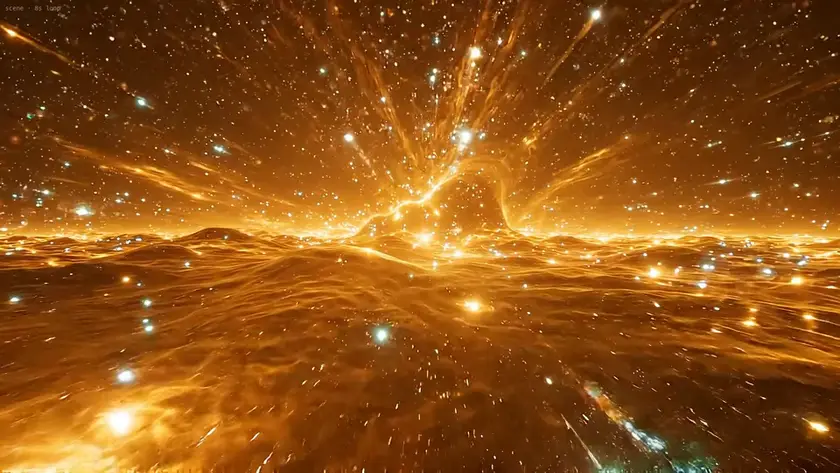
A documentary visualization of the Plasma Cosmology family. A vast warm-gold luminous plasma medium fills the entire frame, dense and energetic, with fine particulate textures and bright current filaments distributed throughout. Across the eight-second shot the interior textures stretch and elongate radially outward toward the frame edges, suggesting the cosmic-scale plasma instabilities and Birkeland-current dynamics the family proposes as the dominant structure-forming process. The camera holds nearly still at the center of the medium while the medium itself transforms, conveying electromagnetic forces and plasma physics, not gravity, as the shapers of cosmic structure.
- Family status
- Fringe
Basis: indirect
Its support comes from plasma physics on smaller scales, but no plasma model fits the CMB spectrum, light elements and other cosmological data together.
- Variant status
- Rejected by observation
- Proposed
- 1991 and 2022
- By
- Eric Lerner
- Sources
- 7: 5 established, 2 debated
- Reviewed
Citations per source
Reader votes
No votes yet on this variant.
Vote if you find the argument convincing. One vote per network.
0 votes for this variant
4What would test it
3 predictions
- CMB arises from thermalized starlight processed by intergalactic dust
- Galaxies at high redshift should not show surface brightness dimming consistent with cosmic expansion
- Plasma processes account for galaxy rotation without dark matter
5Where it breaks
3 objections, plus 3 shared
- The CMB blackbody spectrum is too precise to be reproduced by dust thermalization
- Surface brightness analysis of JWST data with proper k-corrections and sample selection remains consistent with ΛCDM
- Has not produced a quantitative fit to the combined dataset of CMB, BAO, SNe, and large-scale structure
Go deeper
Technical register
Stated precisely
Eric Lerner's plasma cosmology rejects the Big Bang entirely, claims the CMB is thermalized starlight via intergalactic dust, and has argued (most recently in 2022) that JWST images of early galaxies disprove ΛCDM.
Lerner's plasma cosmology builds cosmic structure from plasma filamentation and Birkeland-style currents rather than gravitational collapse, attributes flat galaxy rotation curves to electromagnetic effects rather than dark matter, and, like Quasi-Steady-State Cosmology, explains the cosmic microwave background as starlight thermalised by a fog of intergalactic dust or metallic whiskers, with the redshift not arising from cosmic expansion (Lerner 1991, 1995). In 2022 he argued that early JWST deep-field galaxies, appearing too bright, too large, and too mature for their epoch, falsify the standard galaxy-formation timeline and favour a static universe.
The central claims do not survive scrutiny. The cosmic microwave background blackbody spectrum is measured to better than one part in ten thousand, a precision that dust thermalisation cannot reach without leaving spectral distortions, and an intergalactic medium dense enough to thermalise starlight would itself blur and redden distant sources. The surface-brightness and supernova time-dilation tests both favour expansion over a static universe once proper k-corrections and sample selection are applied. The JWST early-galaxy tension is real, but it is being addressed within standard cosmology through revised star-formation efficiency rather than by discarding expansion, and Lerner's JWST analysis remains unpublished in major peer-reviewed cosmology journals. The standing is rejected.
- redshift
- The stretching of light to longer wavelengths, used as the primary measure of how fast distant objects recede from us.
- dark matter
- A form of matter that interacts gravitationally but emits no light, making up about 27 percent of the universe.
6Who built it, and when
- 1
Lerner (1991). The Big Bang Never Happened
Random House
debated
no count, pre-arXiv
- 2
Lerner (1995). Alternative explanation of the cosmic microwave background
debated
no count, pre-arXiv
- 3
Lerner, Falomo & Scarpa (2014). UV surface brightness of galaxies from the local Universe to z ~ 5
Int. J. Mod. Phys. D 23, 1450058
established
no count yet
- 4
Goldhaber et al. (2001). Timescale Stretch Parameterization of Type Ia Supernova B-band Light Curves
ApJ 558, 359
established
279 citations
- 5
Blondin et al. (2008). Time Dilation in Type Ia Supernova Spectra at High Redshift
ApJ 682, 724
established
no count yet
- 6
White et al. (2024). The Dark Energy Survey Supernova Program: Slow supernovae show cosmological time dilation out to z ~ 1
Mon. Not. Roy. Astron. Soc. 533, 3365
established
no count yet
- 7
Ćirković (2018). Alternative Explanations of the Cosmic Microwave Background: A Historical and an Epistemological Perspective
Stud. Hist. Phil. Sci. B 62, 1
established
no count yet
Plasma-Based Alternative Cosmologies, all 3 variants
Lead variant first, then by year
- Peratt Plasma Structure Formation1986
- Alfvén-Klein Ambiplasma Cosmology1960s
- Lerner Plasma Universethis page1991 and 2022
- Compare two variants
- Up next: Peratt Plasma Structure Formation
- Another answer to the same question: Standard Big Bang
Spotted an error? Have a source to add?
Prefer not to have your message stored?
Send it through the contact form instead, with the subject filled in. Contact messages are emailed, not stored.